The Aircraft · 1913–1918

MORE THAN
THE CAMEL

Eleven types, one drawing office, six years.

The Camel is the one the world remembers. It was never the only one, and it was not the best.

Between the first Tabloid of 1913 and the last Snipe of 1918, one small design office at Kingston-upon-Thames produced a succession of aeroplanes that ran ahead of the field almost continuously — a racer that beat the French at their own game, the first British aircraft to fire through its own propeller, the first to land on a moving ship, the first to carry a torpedo from a carrier deck, and a fighter the enemy admired so openly that thirty-four German prototypes were built in imitation.

They were drawn by Herbert Smith, tested by Harry Hawker, and built by hand, mostly by people who had never seen an aeroplane before 1914. This is what the name is actually made of.

1913First Tabloid
32Types designed
18,000+Aircraft built
1Drawing office
1913

TABLOID

Sport & Scout · The First Sensation

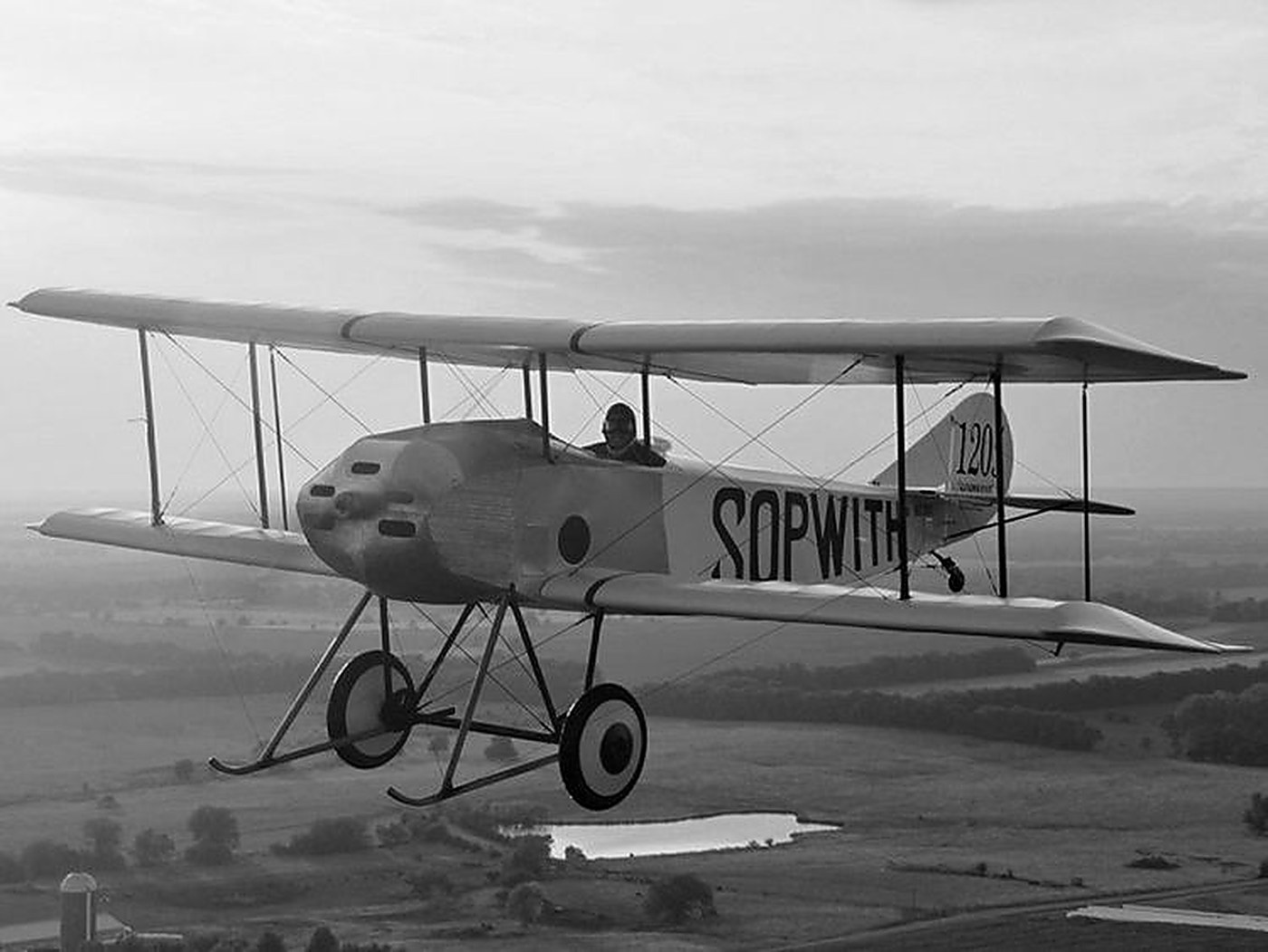
Harry Hawker first flew it at Brooklands in November 1913. It was tiny, it sat two side by side, and at Farnborough it reached 92 mph carrying a passenger and climbed to 1,200 feet in a minute. Nothing else in Britain came close. The press named it the Tabloid, after the compact medical kit.

In April 1914 a floatplane version was prepared for the Schneider Trophy at Monaco. On its first taxiing trial the single central float flipped the machine straight over; it sat in the water for hours. With no time to build new floats, the Kingston works sawed the original one in half down the middle and bolted the halves on as a pair.

It worked. On 20 April 1914 Howard Pixton won the Schneider at 86.8 mph — the first international contest ever won by a British aeroplane — then flew two extra laps to set a world seaplane speed record.

First British machine to win
a major international contest
Sopwith Tabloid in flight
1915

1½ STRUTTER

Two-Seater · The Gun Through the Propeller

Named for the odd short-and-long strut arrangement bracing its top wing, the 1½ Strutter was the first Sopwith built for war rather than adapted to it — and the first British aeroplane to carry a machine gun synchronised to fire through the propeller arc.

That single fact changed air fighting. Before it, British pilots fired at angles, over the top wing, or trusted a gunner. After it, the pilot aimed the aeroplane.

It served as fighter, bomber and reconnaissance machine, flew from Royal Naval Air Service platforms mounted on warship turrets, and was built under licence in France in far greater numbers than in Britain.

First British aircraft with
a synchronised forward gun
Photograph slot
First British aircraft with
a synchronised forward gun
1916

PUP

Scout · The Sweetest Thing Sopwith Built

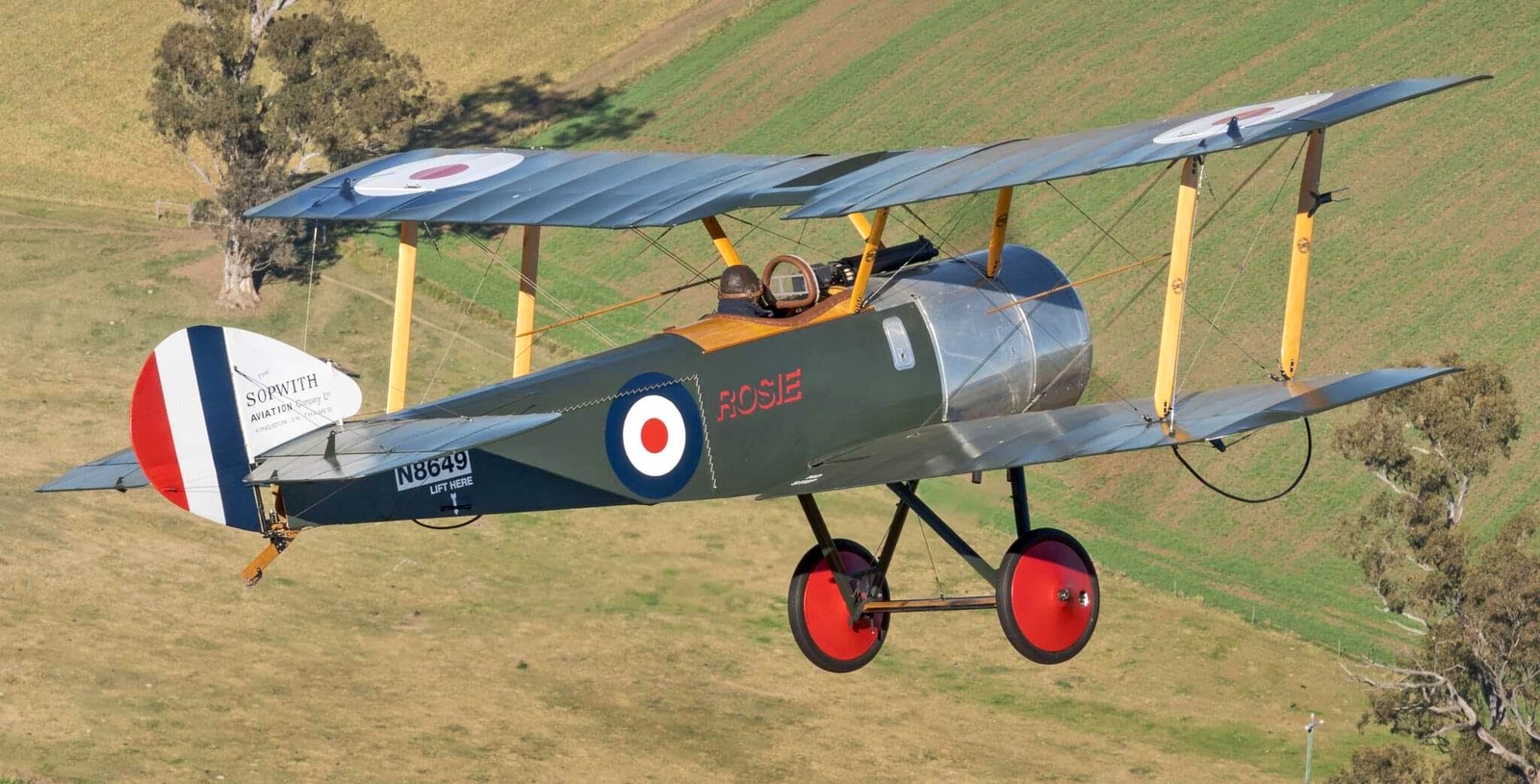
Officially the Sopwith Scout. Everyone called it the Pup, because beside the 1½ Strutter it looked like its offspring, and the name stuck so completely the Admiralty gave up objecting.

Pilots loved it past reason. It was light, honest and unusually forgiving, and it held its height in a turn better than anything the Germans had. It is the aeroplane most often named when Great War pilots were asked which they would rather fly.

On 2 August 1917 Squadron Commander Edwin Dunning flew a Pup alongside HMS Furious as she steamed at 26 knots into Scapa Flow's wind, side-slipped it over the bow and let the deck crew grab rope toggles from his wings. It was the first landing of an aircraft on a moving ship. Five days later he tried again, the engine failed, and he went over the side and drowned in the cockpit. Every carrier landing since traces to that afternoon.

First landing on a moving ship
HMS Furious · 2 August 1917
Sopwith Pup reproduction in flight
1916

TRIPLANE

Fighter · The Machine the Enemy Copied

Herbert Smith's answer to a simple problem: a pilot needs to see. Three narrow wings gave the view of a monoplane with the lift of a biplane, and ailerons on all six wing panels made it savage in a roll. Hawker looped it three times within three minutes of its first take-off.

It climbed like nothing else in the sky. In April 1917 two Triplanes attacked a formation of fourteen German aircraft and, three-quarters of an hour later, had shot down three and scattered the rest.

Manfred von Richthofen called it the best Allied fighter of that moment, and German industry agreed so emphatically that thirty-four triplane prototypes followed — one of which became the Fokker Dr.I. The most famous Sopwith Triplanes were the black-cowled machines of Naval 10's all-Canadian B Flight under Raymond Collishaw: Black Maria, Black Prince, Black Death, Black Sheep, Black Roger. They claimed 87 German aircraft in three months.

34 German prototypes followed
including the Fokker Dr.I
Photograph slot
34 German prototypes followed
including the Fokker Dr.I
1917

CAMEL

Fighter · The One Everyone Knows

Two Vickers guns under a humped fairing gave it the name. Nearly all its weight — engine, guns, pilot, fuel — sat in the front seven feet, and the torque of a big rotary did the rest: it turned right faster than any aeroplane alive and would kill a careless novice on take-off.

Flown well, it was untouchable. The Camel is credited with more aerial victories than any other Allied aircraft of the war.

The most successful single fighter airframe in RAF history was a Camel — B6313, flown by the Canadian William Barker, which accounted for 46 aircraft and balloons over eleven months. And it is a Camel that a beagle flies, in imagination, on the roof of a doghouse.

More victories than any other
Allied aircraft of the war
Photograph slot
More victories than any other
Allied aircraft of the war
1917

DOLPHIN

Fighter · Backwards, and Better For It

The Dolphin's top wing sits behind the lower one — negative stagger, the reverse of every other machine on this page — so the pilot's head projected through the centre-section and he could see, forward and up, as no fighter pilot had before.

It unsettled people. Crews were convinced it would break their necks if it turned over, and the water-cooled Hispano-Suiza was troublesome early on.

Those who persevered found a fast, strong, heavily armed machine that fought well at altitude and, in the last months, was among the better fighters on the Western Front. It is the Sopwith least remembered and most quietly admired.

Negative stagger · the pilot
could finally see upward
Photograph slot
Negative stagger · the pilot
could finally see upward
1918

SNIPE

Fighter · The Last and the Best

Herbert Smith's successor to the Camel: bigger, a Bentley BR.2 of 200 hp, twin Vickers, and — crucially — no vice. It gave a pilot everything the Camel gave without demanding a Camel pilot to fly it. Many judged it the best Allied fighter on the Western Front at the Armistice.

On the morning of 27 October 1918, fifteen days before the war ended, Major William Barker was flying Snipe E8102 back to a depot when he engaged a two-seater over the Forêt de Mormal and was set upon by a large formation of Fokker D.VIIs.

He was shot through both thighs and his left elbow was destroyed. He fought the descending battle to the ground, brought down three more, and force-landed inside Allied lines in front of the Canadian Corps, who watched the whole thing. He was awarded the Victoria Cross. The fuselage survives in Ottawa.

Barker's Victoria Cross · Snipe E8102
27 October 1918
Photograph slot
Barker's Victoria Cross · Snipe E8102
27 October 1918
1918

CUCKOO

Torpedo Bomber · The Idea Before Its Time

A single-seat landplane built to carry an eighteen-inch torpedo and fly it off the deck of a carrier — the first aircraft of its kind anywhere. It reached HMS Argus in October 1918, weeks too late for the strike on the German fleet it was conceived for.

The idea did not go away. Naval staffs abroad read the Cuckoo carefully, and what Sopwith proposed at Kingston in 1917 — torpedo aircraft, launched from a carrier, against capital ships at anchor — is recognisably what happened at Taranto in 1940 and at Pearl Harbor in 1941.

It is the clearest example of the Sopwith habit: the company kept building the aeroplane the next war would need.

First carrier-borne
torpedo landplane
Photograph slot
First carrier-borne
torpedo landplane
An Aside, Which Turned Out To Matter

THE FLYING ZOO

The Pup was never called the Pup. Officially it was the Sopwith Scout, and the Admiralty meant it. But pilots looked at the little machine standing next to the 1½ Strutter and saw a puppy beside its mother, and the name went round the squadrons in a week.

The authorities objected. The name was undignified — that was the official word — and for a while there was a genuine effort to make everyone say Scout, or better still, Admiralty Type 9901.

Nobody said Admiralty Type 9901.

So Kingston did the sensible thing and stopped fighting. From the Pup onward, every Sopwith aeroplane but one took the name of an animal. The lone holdout was the Triplane, which was presumably felt to have earned an exemption.

PupCamelDolphinSnipeSalamander CuckooDoveSwallowGnuHippo

Aviation history has called it the Flying Zoo ever since. It is the one moment in the whole account where the company is not being formidable — where a firm that built the deadliest fighter of the war let its customers name the products and then put the joke on the drawings.

A company that lost an argument about dignity,
and was right to lose it.

THE HABIT OF BEING FIRST

Read them in order and a pattern appears that no single aeroplane shows on its own. Kingston was rarely the biggest works and never the loudest, but between 1913 and 1918 it was repeatedly the first — and the industry that followed took its cues from a drawing office beside the Thames.

Sir Thomas was twenty-four when he founded it. He lived to see the jet age, and to be asked, at a hundred years old, what he made of it.